
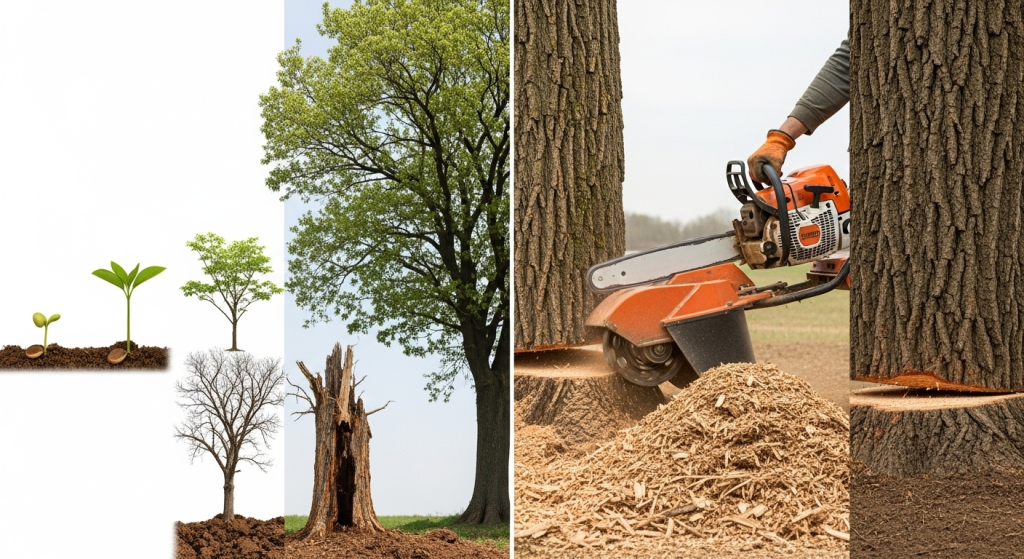
Overseeing the trees on your property encompasses much more than just pruning; it requires recognizing potential hazards, safely eliminating dangerous trees, and addressing the concluding phase: stump removal. In the humid climate of Malaysia, effective tree management is essential for ensuring safety, safeguarding property, and preventing pest issues. From initial risk evaluations to treatments following tree removal, every phase contributes to maintaining a secure and prepared landscape.
1. Pre-Emptive Tree Removal: Assessing and Mitigating Risk
The safest tree removal is often the one done before the tree fails. Professional arborists in Malaysia, often certified under the Tree Risk Assessment Qualification (TRAQ) by the International Society of Arboriculture (ISA), follow a structured evaluation method to assess danger levels.
Three Main Risk Factors:
Likelihood of Failure: How probable it is for a branch or the whole tree to fall (Improbable, Possible, or Probable).
Likelihood of Impact: How likely the tree or its parts are to strike a target if failure occurs (Very Likely or Unlikely).
Consequence of Impact: The severity of potential damage or injury (Negligible, Minor, Significant, Severe).
Common Scenarios:
Low Risk: A small dead branch above a fence.
Moderate Risk: A decaying limb over a walkway.
High Risk: A large, leaning tree over a house.
Visual Signs of Tree Failure:
At the Base (Root Zone): Heaving or cracked soil and mushroom growth near the trunk indicate root instability or rot.
Trunk and Branches: Deep vertical splits, cavities, missing bark, or deadwood signal internal decay and weakness.
Crown/Leaves: Sudden yellowing, wilting, or dieback in leaves shows stress or disease compromising structural integrity.
2. Post-Storm Tree Inspection in Malaysia’s Rainy Season
After heavy rain and strong winds, a post-storm inspection ensures safety. Never approach fallen trees or branches near power lines—always contact professionals.
Key Areas to Check:
Root Zone: If the tree leans more than before or soil is mounded on one side, the root plate may be failing.
Trunk: Deep vertical cracks or loss of more than one-third of the bark usually mean the tree cannot recover.
Major Limbs: Large, fractured branches hanging over houses or public areas are severe hazards.
Crown: When more than half of the canopy is damaged or lost, professional removal is usually necessary.
3. Stump Gone, Now What? Choosing the Right Stump Removal Method
After felling a tree, the remaining stump can become an eyesore—and worse, a pest magnet. In Malaysia’s warm, damp conditions, stumps attract termites and carpenter ants, posing a direct risk to nearby structures. Choosing the right removal method depends on your budget, timeline, and future land use plans.
Main Methods of Stump Removal:
Stump Grinding (Mechanical): Uses a machine to grind the stump 6–12 inches below soil level.
Pros: Fast (a few hours), clean, suitable for gardens, minimal damage to surroundings, wood chips reusable as mulch.
Cons: Root system remains underground, cannot replant a new tree immediately, and must check wood chips for fungus.
Stump Excavation (Full Removal): Entire stump and roots are dug out with machinery.
Pros: Immediate clearance, ready for new trees, patios, or foundations, and removes all pest risks.
Cons: Highest cost, large hole left behind requiring soil replacement, may disrupt landscape.
Chemical Decomposition: Potassium nitrate accelerates rotting, but takes months to years.
Pros: Cheapest DIY method, low physical effort.
Cons: Extremely slow (3–10 years), promotes termite infestation, unsafe near buildings.
4. The Termite Factor: Why Stump Removal Is Essential
In Malaysia, the primary cause for the prompt removal of stumps is termite infestation. A decaying stump serves as both a food source and a habitat for subterranean termites. Once colonies establish themselves, they can navigate through old root tunnels directly to your home, where they will feed on wooden foundations and structures. Consequently, professional arborists highly advise mechanical stump removal methods, such as grinding or excavation, to prevent infestations from occurring.
Conclusion: Prioritize Safety, Speed, and Prevention
Effective tree management in Malaysia revolves around three priorities—safety, pest prevention, and long-term property protection.
Safety First (Before Removal): Regularly inspect trees using TRAQ principles. Trees with root heaving, trunk splits, or severe canopy loss—especially after storms—should be removed promptly.
Avoid DIY Chemical Methods: Malaysia’s humid climate accelerates decay and attracts termites, making chemical decomposition unsafe and unreliable.
Choose the Right Professional Method:
Use Stump Grinding for gardens or lawns where speed and cost efficiency matter.
Choose Stump Excavation if you plan to rebuild, landscape, or replant, as it ensures full removal of roots and pests.
In short, professional tree assessment, safe removal, and mechanical stump disposal are the best ways to maintain a secure, pest-free, and ready-to-redevelop landscape in Malaysia.