
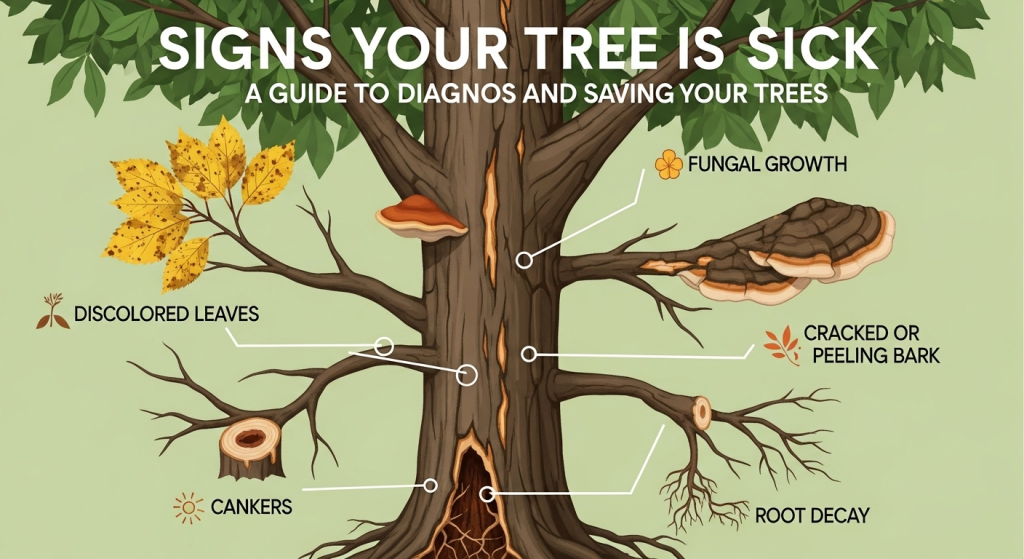
A stunning, healthy tree can serve as the focal point of your yard; however, what should you do when it begins to appear somewhat unwell? Early detection of the symptoms of ailing trees is essential. The earlier you recognize an issue, the greater your chances of rescuing your tree and averting a possible safety risk.
Understanding what indicators to observe can assist you in determining whether your tree merely requires some attention or if it is necessary to seek the assistance of a professional. Below are the most prevalent signs that indicate your tree is experiencing distress.
Clues in the Leaves and Branches
The most prominent sections of a tree are frequently the initial indicators of distress. It is essential to monitor the developments occurring above the soil.
- Discolored or Wilting Leaves: Should the leaves of your tree begin to turn yellow, brown, or black unexpectedly, it may signify a disease, a lack of nutrients, or an infestation of pests. Although some leaves naturally alter their color in the autumn, an abrupt change during spring or summer serves as a warning sign.
- Premature Leaf Drop: A healthy tree retains its leaves until the conclusion of its growth cycle. If your tree is shedding its leaves prematurely, it indicates that it is under stress.
- Dead Branches or “Dieback”: A robust tree should possess pliable branches. If you observe branches that are fragile and easily breakable, or if the tips of the branches are dying, it is a significant indication of a health concern. This phenomenon known as “dieback” may suggest an issue with the roots or the presence of a disease.
Warning Signs on the Trunk and Bark
The trunk serves as the central part of the tree, and its state can provide significant insights into the tree’s overall health.
- Cracks or Splits: Prominent vertical cracks in the trunk may indicate internal weakness. Although some cracks are typical, deep or widening splits can render the tree structurally unstable.
- Peeling or Flaking Bark: Generally, trees exhibit a relatively uniform bark texture. If the bark begins to peel or shed in substantial patches, it may indicate an infection or pest infestation.
- Fungus or Mushrooms: The appearance of mushrooms or other fungal growth, particularly at the trunk’s base or where branches connect to the trunk, is a critical indicator of internal decay. The fungus thrives on the decaying wood within the tree.
- Holes or Tunnels: Be vigilant for small, uniform holes or serpentine tunnels in the bark. These are frequently indicative of boring insects, which can inflict considerable harm to the tree’s vascular system.
Examining the Roots and Base
The health of a tree begins at its roots. It is essential to examine the base and the adjacent soil.
- Root Rot: Should the soil surrounding the tree’s base remain persistently moist and you observe indications of decay on the roots, it is possible that a root rot problem exists. This condition can render the tree unstable and hinder its ability to absorb sufficient nutrients.
- Heaving or Raised Soil: If the area around the tree’s base appears elevated or exhibits an unusual lumpiness, it may indicate that the roots are either damaged or have been disturbed. Such a situation can jeopardize the tree’s stability and overall health.
What to Do If You Spot a Problem
If you have recognized one or more of these indicators, there is no need to panic. It may not be necessary to fell your tree at this moment. Begin by providing it with additional care—ensure it receives adequate water and that the soil remains healthy.
Nevertheless, the most crucial action is to seek advice from a certified arborist. An arborist is a professional in tree care who can precisely identify the issue and suggest an appropriate treatment strategy. They possess the expertise and equipment to either preserve your tree or, if required, safely remove it. Never try to take down a large, unhealthy tree by yourself.
Conclusion
Your trees represent significant assets to both your home and the surrounding environment, offering shade, aesthetic appeal, and clean air. By routinely examining the leaves, branches, trunk, and roots, you position yourself as the primary protector of your tree. Identifying an issue early can distinguish between a straightforward treatment and an expensive or hazardous removal. Remain vigilant, and if uncertain, keep in mind that the knowledge of a certified arborist can assist in maintaining your trees as a healthy and attractive component of your landscape for many years ahead.