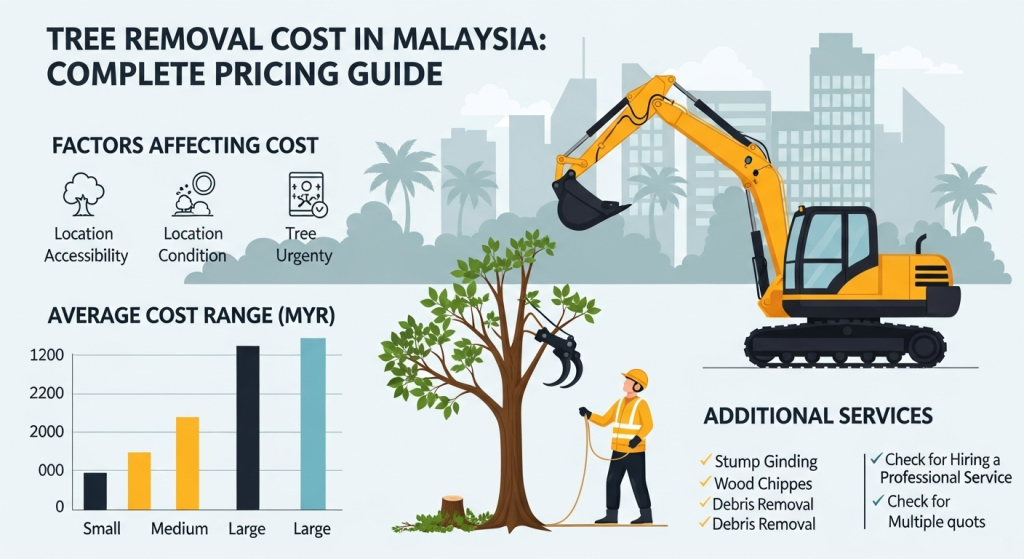
The cost of tree removal in Malaysia can differ greatly based on the complexity of the task, the location, and the species of tree involved. Transparency is essential; therefore, we have outlined the primary factors that affect the final price (in Malaysian Ringgit – RM) of professional tree cutting services.
Key Factors Determining Tree Removal Costs
The total price quoted by an arborist or tree cutting service will generally be based on the following six variables:
1. Size and Height of the Tree
This is the single most important factor. Taller, wider trees require more time, specialized rigging equipment, and a larger crew for safe removal.
Small (under 20 feet / 6 meters): Typically shrubs or young decorative trees. Less complex.
Medium (20 – 50 feet / 6 – 15 meters): Common residential trees like mature mango or smaller oil palms. Requires climbing and sectional removal.
Large (over 50 feet / 15 meters): Massive forest species or old heritage trees (like Raintree or Tualang). These often require cranes or advanced rigging, significantly increasing the cost due to risk and complexity.
2. Tree Species and Wood Density
The type of wood impacts the difficulty of cutting and the weight of the debris.
Softwood: Easier and faster to cut.
Hardwood: Dense wood (like mature Meranti or some types of Jelutong) is heavier, harder on tools, and takes longer to process, which can increase the labour cost.
3. Accessibility and Location (Urban vs. Rural)
How easily can the crew and equipment (lorries, chippers, cranes) access the tree?
Easy Access: Tree located in an open yard with direct access for heavy vehicles.
Complex Access: Tree located in a narrow alley, a gated community (taman), or close to traditional kampung houses where manual labour and hauling are necessary. Limited access always adds to the labour cost.
4. Proximity to Structures and Hazards
Safety is paramount, and high-risk jobs cost more due to the need for precise control (technical rigging).
High Risk: Trees leaning over a roof, near power lines (especially TNB high-tension cables), close to boundary walls, drainage pipes, or pools.
Low Risk: Trees in open fields or far from any residential or utility hazards.
5. Additional Services Requested
The base price usually includes cutting and lowering the tree sections. The client must specify what happens to the debris:
Hauling/Disposal: Do you want the contractor to haul all the wood and branches away? This is typically included but should be confirmed.
Chipping: Grinding branches into mulch.
Stump Grinding: Removing the remaining stump below ground level. This is often a separate, add-on service.
6. Majlis (Local Council) Permit Requirements
In most Malaysian cities and municipalities (like DBKL, MBPJ, MBSA), you need a permit (kelulusan) to cut down mature or protected trees, especially on residential property. While we can assist with the process, the application fee and the administrative effort involved are factored into the total service cost.
Get a Free, No-Obligation Site Quotation
Since no two trees are exactly alike, the only way to get a precise cost is to have a certified arborist perform a site inspection.
Contact us today for a free consultation. Our team will assess the complexity, identify all risks (TNB lines, nearby structures), and provide a fixed price quote covering all labour, disposal, and safety protocols required for a safe removal.